For almost four years, Valentyna Vyhinna from Mariupol waited for news of her son Serhii, an officer in the Armed Forces of Ukraine who was being held in russian captivity. For years, she contacted government institutions and took part in rallies in support of prisoners of war. In February 2026, she finally received the long-awaited news: her son was coming home. The Mariupol resident shared her story with the Museum of Civilian Voices founded by the Rinat Akhmetov Foundation.
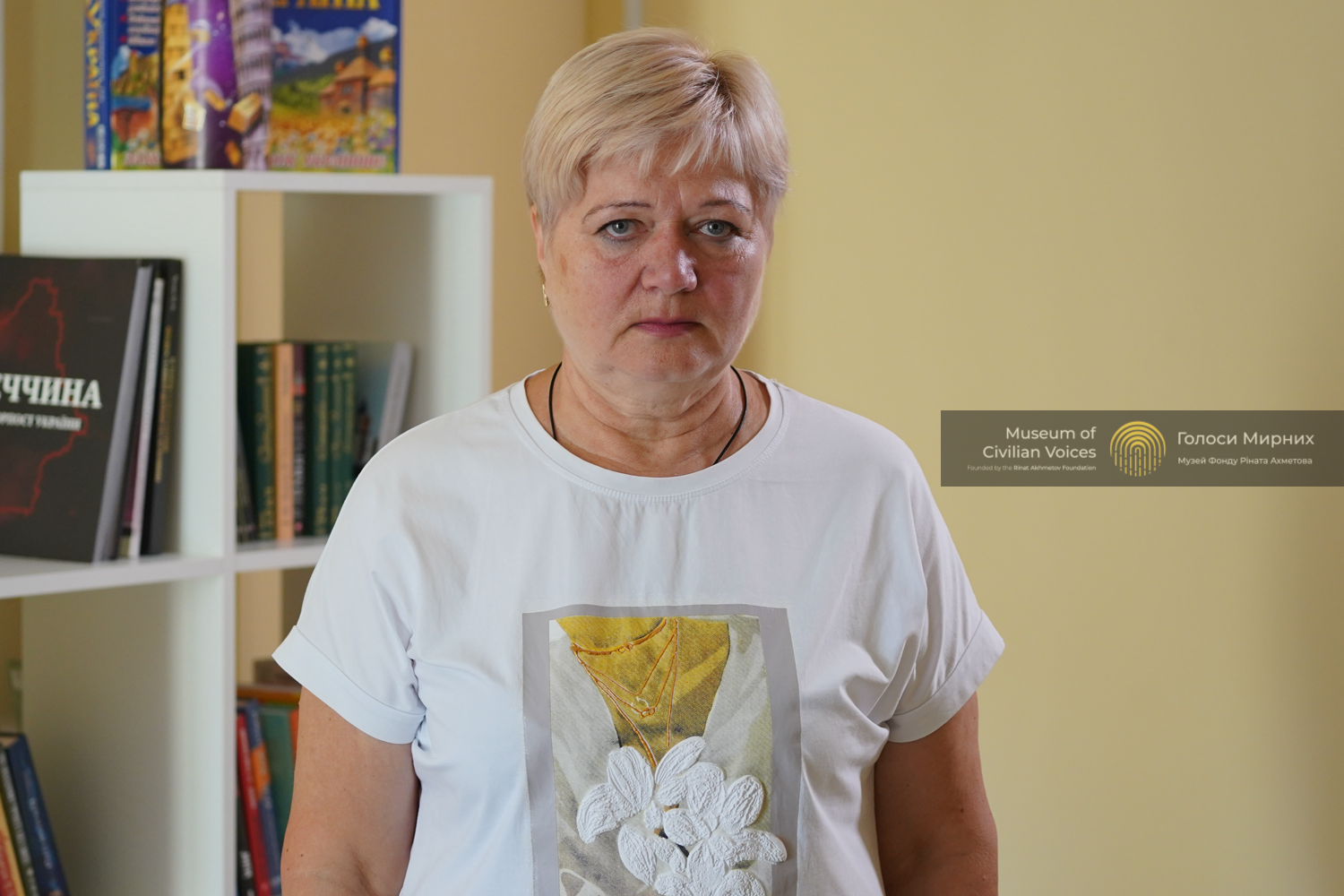
“When he was exchanged, it was a shock. My daughter-in-law told me that a letter had arrived. There are 25 floors in the building, and I think everyone could hear us screaming with emotion. He was then immediately sent for recovery because he had been wounded. He is still undergoing rehabilitation,” the woman says.
The news of her son’s return brought her the greatest happiness after everything her family had been through. At the beginning of the full-scale war, Valentyna and her husband found themselves on the brink of life and death in besieged Mariupol. On one occasion, they miraculously survived a shelling attack: an inner premonition told Valentyna to go down to the basement. Moments later, a shell hit their room.
“There was no air raid alert at the time. It was as if I had dreamed that we absolutely had to go down to the basement. I called my husband from the kitchen, and as we were going downstairs, we heard something flying overhead and glass shattering. Later, we saw that there was a huge crater right where the sofa was, the sofa where my husband and I had been lying,” Valentyna recalls.
After that, they did not dare to leave the basement for a long time. They spent almost a month sheltering underground and trying to survive in temperatures of −11°C. Marik, the German Shepherd belonging to their son, was with the couple. During one of the shelling attacks, the dog was wounded and lost an eye. Valentyna patiently nursed him back to health.
“Our son’s dog is like our own child. We took him into our home. At the time, my neighbor, who was a nurse, told me he would not survive. But I believed he would recover. There was no food left by then, and my neighbor brought me two eggs so I could feed the dog using a syringe. Later, other neighbors gave me some minced meat, and I made him a little soup. That was when he started getting back on his feet,” the woman says.
Later, their neighbors warned them that the area was going to be razed to the ground. Valentyna and her husband decided to leave, taking their son’s German Shepherd with them. The journey was extremely dangerous: everywhere they looked, there were ruins and burned-out cars.
“We first drove to some friends. When they saw us, they stopped and asked how we had managed to get through at all, because the whole area had been mined. A motorcyclist was riding ahead of us. He was blown to pieces, and his passport was found on the roof of a building. We stayed with our friends. They had a stove and a large garage,” Valentyna says.
They stayed with their friends for about a week, but after another strike hit the yard, they were forced to flee once again. Thanks to Valentyna’s husband, who knew the local roads and paths well, the couple managed to reach Zaporizhzhia. The family now lives in Chernivtsi.
Watch the story of Valentyna Vyhinna and her family here:
The Museum of Civilian Voices founded by the Rinat Akhmetov Foundation has collected more than 145,000 stories about the war. It is the world’s largest archive of testimonies from Ukrainian civilians affected by russian aggression.