
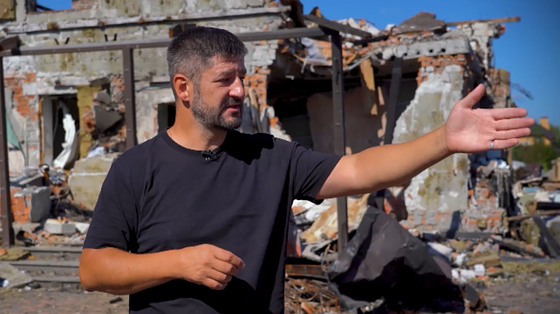
How the village of Khalepia preserves Trypillian treasures and why they are important to us today. When russian troops invaded the Kyiv region, the village of Khalepia hastily packed clay shards into cardboard boxes. Artefacts that were painted thousands of years earlier. Vasyl Trubai, a former teacher of film drama, retired as a caretaker of the local museum, taking the exhibits from the hall to the attic and then to his own house. For him, these are not just fragments of clay – they are roots that must be preserved at all costs.
The village of Khalepia has a unique treasure – the world’s only museum of the discoverer of Trypillian culture, Vikentii Khvoika. Opened in 2009, the museum existed for a long time in copies. Only in the 2020s did real artefacts brought by archaeologists appear here.
Visitors can not only look at them behind glass, but also hold them in their hands! “I asked the archaeologists for permission, – explains Trubai. – And now anyone can touch a plate that is more than six thousand years old with their fingers”. This is a completely different experience than just a tour – it’s a physical touch of history.
Paradoxically, it was during wartime that the museum was given a new life. A few kilometres from the museum is the village of Vytachiv. It is known for its high cliffs above the Dnipro River and the special energy that everyone who comes here feels. It was here, at the beginning of the Great War, that the President of Ukraine addressed the nation. At that time, these hills became a symbol of resilience and steadfastness. Later, people were drawn to both Vytachiv and the museum. Because they found a breath of fresh air here. “People leave the museum changed,” says Trubai. – “They understand: life goes on. There is something to hold on to.”
In Khalepia, visitors learn that many Trypillian customs have miraculously survived to the present day. For example, the habit of not passing things over the threshold, knocking three times on a tree, or carrying a bride in your arms to a new house – all of these have their roots in rituals that are more than seven thousand years old. This is where history comes alive: beliefs turn into a living thread that connects modern Ukrainians with their distant ancestors.



.png "Names")


