
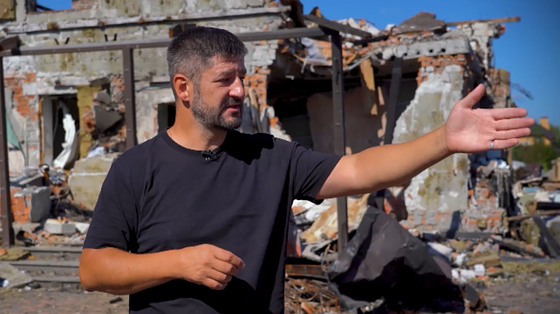
Mykhailo Vysotskyi spent his whole life explaining to Ukrainians how the universe works. But on July 2, 2026, a russian ballistic missile destroyed his own world – the flat that held 150 years of family memories, decades of scientific archives, a library, paintings and materials for his doctoral thesis.
A Candidate of Physical and Mathematical Sciences, a lecturer at Taras Shevchenko National University of Kyiv and one of Ukraine’s most renowned science communicators, he lost not only his home but also decades of his own work and his family’s scientific legacy.
Mykhailo’s father, the renowned Ukrainian theoretical physicist Volodymyr Vysotskyi, devoted his entire life to research aimed at helping humanity dispose of radioactive waste more safely.
This flat was a place where the history of Ukrainian science literally lived side by side with the history of Ukrainian cinema. The director Serhii Paradzhanov used to visit here, coming to see Mykhailo’s grandfather – a film director at the Dovzhenko Film Studio. The flat housed family archives, scientific manuscripts, books, photographs with Nobel laureates, and the legacy of several generations of Ukrainian scientists.
After the strike, Mykhailo was left with virtually nothing. Along with his flat, he lost his equipment, archives, working materials and the ability to continue his main work – popularising science. He was forced to suspend his YouTube channel, which had become a platform for tens of thousands of Ukrainians where physics and the universe were discussed in plain language. The story quickly spread beyond the scientific community. Friends, colleagues, scientists and thousands of subscribers began sharing it on social media. It was this publicity that caught the attention of concerned members of the public and philanthropists.
Mykhailo’s story came to the attention of the founder of the Rinat Akhmetov Foundation. Moved by the plight of the scientist’s family, the philanthropist decided to purchase a new flat for Mykhailo in Kyiv. In addition, the Foundation is exploring the possibility of joint projects to promote STEM education and the exact sciences.
This interview is not just about the loss of a home. It is a conversation about the future of Ukrainian science, the “brain drain”, scientists’ responsibility to society, and a question facing the whole country today: how can we retain the people who are capable of shaping its future?



.png "Names")


